NYC Sidewalk Repair: Who Is Responsible, DOT Violations and Costs
In New York City, the property owner is responsible for repairing the sidewalk in front of their property, not the city. If the sidewalk is cracked, raised or broken, NYC DOT can issue a violation, and you can either hire a contractor to make a compliant repair under a DOT permit or wait for DOT to do the work and send you the bill.
This guide covers who is responsible for sidewalk repair, how violations generally work, what to do about tree-root damage, what a proper concrete sidewalk repair involves, and what it typically costs in Queens, Brooklyn and Staten Island.
Who is responsible for sidewalk repair in NYC?
The short answer: the owner of the adjacent property. New York City law makes owners responsible for installing, repairing and maintaining the sidewalk along their frontage, including corner lots on both street sides. That applies whether you own a detached house in Tottenville, a semi-attached two-family in Ozone Park, or a mixed-use building on a commercial strip in Sunset Park.
Tenants are generally not responsible unless a commercial lease shifts the duty to them. Condo and co-op buildings handle sidewalks as a building expense through the board or managing agent.
Sidewalk vs curb: are they the same responsibility?
Not always. The sidewalk is the walking surface between your property line and the curb. The curb is the edge that meets the roadway, usually concrete or granite. Responsibility and permits for curb work can be handled differently from sidewalk work, and curb damage tied to a driveway or a private contractor's work may fall on the owner. If your violation or estimate mentions the curb, confirm exactly what is being cited and which permit applies before work starts.
How do NYC sidewalk violations work?
The NYC Department of Transportation inspects sidewalks in response to complaints, as part of planned programs, and when other work is being done on a block. If an inspector finds defects, the owner may receive a Notice of Violation describing the problem squares.
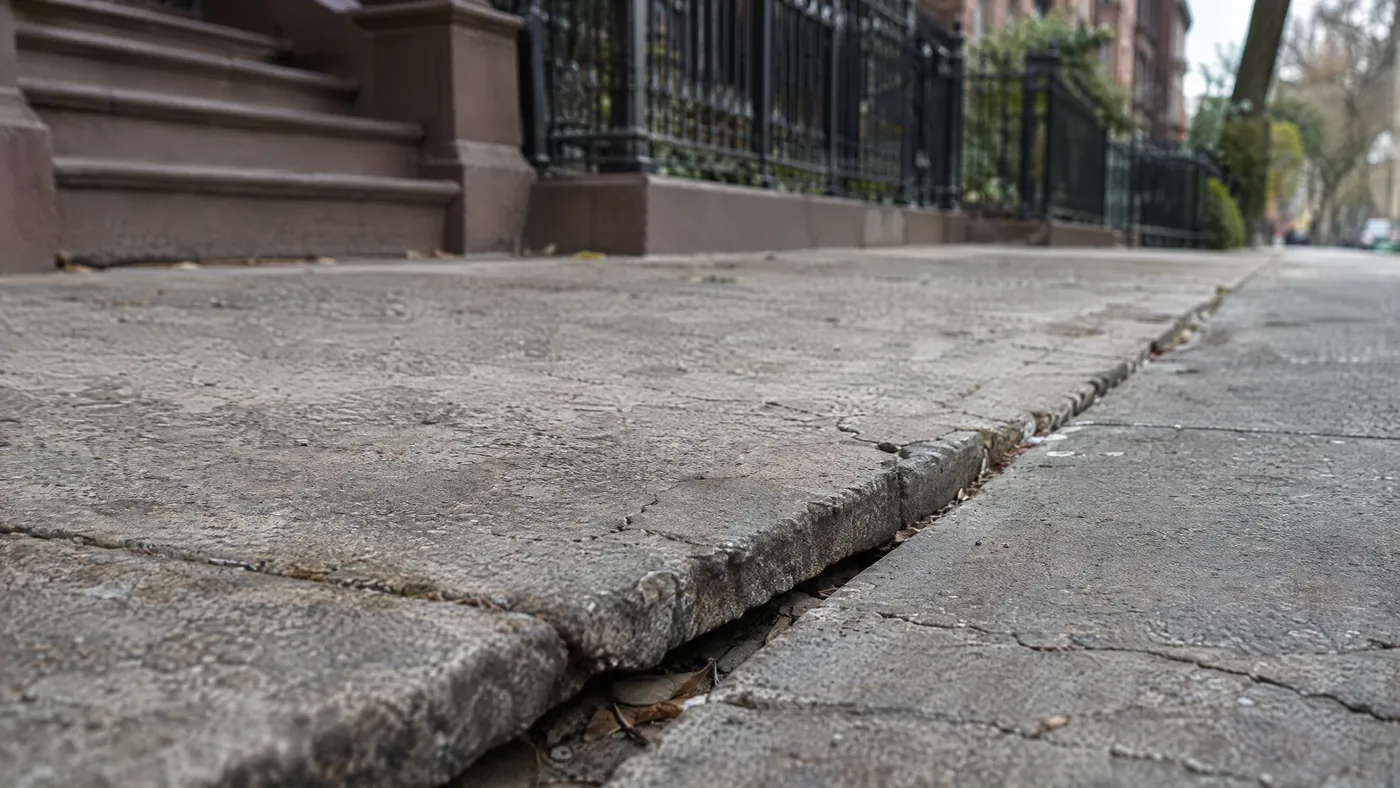
Common defects that lead to a sidewalk violation in NYC include:
- Trip hazards, where one flag is raised above the next, commonly about half an inch or more
- Cracked or broken flags with loose pieces or wide cracks
- Collapsed or sunken sections that hold water or tilt sharply
- Patchwork or non-compliant materials, such as asphalt patches on a concrete sidewalk
- Hardware problems, like raised or broken cellar doors, vault covers or grates set in the sidewalk
Your options after a violation
Once you have a violation, you generally have two paths:
- Repair it privately. Hire a contractor who obtains the required DOT sidewalk permit and repairs the sidewalk to city standards. Keep the permit, invoices and photos so you can show the violation was corrected.
- Let DOT do it. If the defects are not corrected, DOT may include your sidewalk in a city repair contract and bill you for the work. You lose control over scheduling, and unpaid bills can become a lien on the property.
Many owners prefer to repair privately because they can choose the timing, compare prices and fix nearby problems at the same time. Before you sign anything, read the violation carefully and confirm which flags are cited. If you are unsure of your options, 311 can point you to the right DOT office.
Do you need a violation to repair your sidewalk?
No. You can fix a broken sidewalk before anyone complains, and that is usually the cheaper and safer route. The same rule applies: sidewalk work on city property requires a DOT permit, typically pulled by the contractor doing the work.
Trip-hazard liability: why waiting can cost more
A cracked sidewalk is not only a violation risk. NYC law generally shifts liability for sidewalk injuries to the adjacent property owner when the owner fails to maintain it. The main exception is owner-occupied one-, two- and three-family homes used exclusively as residences, where the city generally carries that liability.
Even if you fall under that exception, a raised flag in front of your home is still a hazard for neighbors, delivery workers and anyone pushing a stroller. For landlords and owners of mixed-use or commercial buildings, the exposure is direct. Talk to your insurer about what your policy covers, and fix trip hazards promptly.
If you own rental buildings, sidewalk checks belong on the same list as boilers and window guards. Our home maintenance plans for landlords include seasonal inspections with photos, which makes it easier to catch a lifting flag before it becomes a claim.
Sidewalks damaged by street tree roots
Street trees are a big reason Queens, Brooklyn and Staten Island sidewalks heave. Mature London planes, oaks and maples planted decades ago in small tree pits push slabs up as their roots grow. Neighborhoods like Bayside, Forest Hills, Ditmas Park and much of the North Shore of Staten Island see this constantly.
Here is what to know, in general terms:
- Street trees belong to the city. They are managed by NYC Parks. Owners should not cut roots, remove a street tree, or reshape a tree pit without Parks approval. Damaging a street tree can lead to penalties.
- Parks has repair programs. NYC Parks has run programs that may repair sidewalk damage caused by city trees, with priority for certain one- to three-family residential properties. Eligibility, scope and wait times vary.
- Report it through 311. Describe the damage and the tree. Ask whether your property qualifies for a city tree-related repair and whether you should wait before hiring a contractor.
- If you repair it yourself, your contractor needs to work around the tree carefully, and work affecting the tree or its pit may need Parks sign-off in addition to the DOT permit.
Because programs and rules change, treat this as a starting point and confirm current details with Parks and DOT before you commit to a repair.
What does a compliant concrete sidewalk repair involve?
A proper concrete sidewalk repair is more than pouring new concrete over the old. NYC has specifications for sidewalk construction covering materials, thickness, slope and joints, and a permitted repair must meet them.
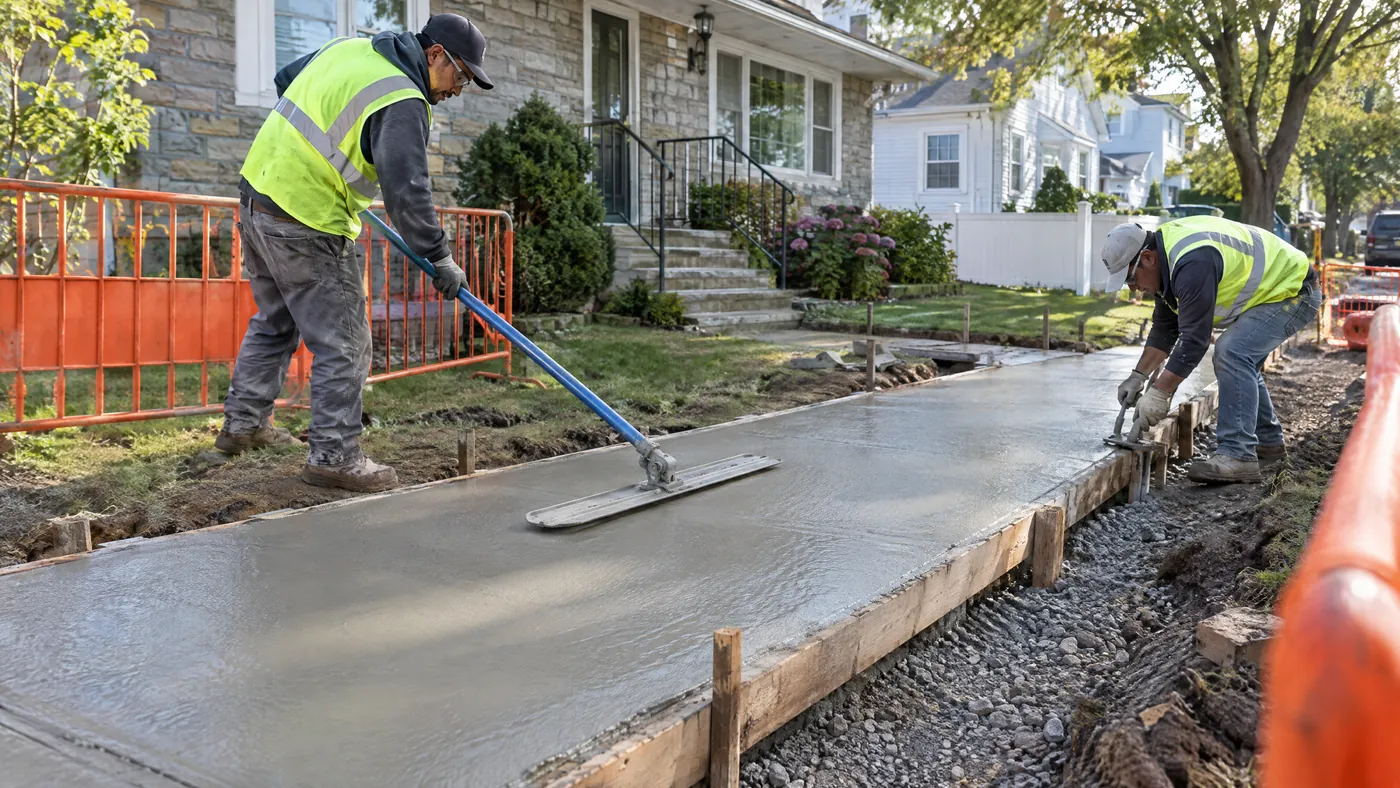
A typical replacement follows these steps:
- Permit and layout. The contractor obtains the DOT sidewalk permit, marks the flags to be replaced, and calls in underground utility markouts before digging.
- Saw-cut and demolition. Damaged flags are cut out at the joints so the repair meets clean edges rather than a jagged patch.
- Base preparation. Soil is graded and a granular base is compacted so the new slab does not settle.
- Forms and reinforcement where required. Forms set the height and slope. Driveway crossings are typically built thicker and may need reinforcement.
- Pour and finish. Concrete is placed, leveled, edged and given a non-slip broom finish, with control joints tooled in to match the existing pattern.
- Curing and protection. The new sidewalk is barricaded while it cures, usually several days before heavy use.
- Close-out. Debris is hauled away and you keep the permit, invoices and photos for your records.
Sidewalks also need to drain toward the street, line up with neighboring flags, and keep corner pedestrian ramps and hardware such as vault covers flush. A good contractor will explain how the new section ties into your neighbors' sidewalk so you do not create a new trip hazard at the property line.
How much does sidewalk repair cost in NYC?
Sidewalk repair cost in New York City depends on how many square feet are replaced, site access, and extras like a driveway apron, tree pit or curb. The ranges below are typical NYC market figures for 2026 and vary by contractor, borough and site conditions. They are not quotes.
| Scope | Typical size | Typical NYC range (2026) |
|---|---|---|
| Spot repair, 1–3 flags | 25 – 75 sq ft | $1,500 – $4,000 |
| Partial frontage, several flags | 75 – 150 sq ft | $3,000 – $7,000 |
| Full frontage, typical row or semi-attached home | 100 – 200 sq ft | $4,000 – $10,000 |
| Corner lot or wide commercial frontage | 250+ sq ft | $9,000 – $20,000+ |
| Driveway apron or curb work added | varies | adds roughly $1,500 – $5,000+ |
Per square foot, concrete sidewalk replacement in NYC commonly lands in the range of about $15 to $35, with small jobs costing more per foot because permits, mobilization and disposal are a fixed cost.
What raises or lowers the price
- Permit and insurance costs built into every job
- Tree roots that require careful hand work around the pit
- Driveway crossings that need thicker concrete
- Cellar doors, vault covers or grates that must be reset
- Corner lots with two frontages and curb ramps nearby
- Bundling with neighbors, which can lower per-flag cost when several adjacent owners hire one contractor together
Always ask for a written, itemized estimate that lists square footage, permit fees, demolition, disposal and any curb or driveway work separately.
How to choose a contractor for NYC sidewalk repair
Sidewalk work happens on public property and is inspected, so who you hire matters. Before you sign:
- Confirm the DOT permit. Ask whose name the permit will be in and when it will be pulled. Work without a permit may not clear your violation.
- Check the DCWP license. Home improvement contractors working on residential property in NYC must hold a Department of Consumer and Worker Protection Home Improvement Contractor license for jobs over $200. Look it up yourself.
- Ask for insurance certificates. DOT requires insurance for sidewalk permits, and you want proof the contractor is covered if someone is hurt or a utility is damaged.
- Get the scope in writing, including which flags are being replaced, curb or driveway work, and how the contractor will handle tree roots.
- Avoid door-to-door pressure. Some outfits canvass blocks after violations go out. Take your time and compare at least two written estimates.
Older homes often have masonry problems beyond the sidewalk, like failing stoops, front steps and brick. If you own a Brooklyn rowhouse, our guide to brownstone brick repointing in Brooklyn covers the next most common exterior repair.
Get a free estimate for sidewalk repair
We handle masonry and concrete repair across Queens, Brooklyn and Staten Island, from a single raised flag to a full frontage, and our crews speak English, Spanish, Bengali, Hindi and Urdu.
Request a free estimate or call or text 929-400-9900. Send a photo of the sidewalk and your violation, if you have one, and we will talk you through the scope, permits and timing for your concrete sidewalk repair.